
India's exports grew by 67.39 per cent to $32.21 billion in May driven by healthy growth in sectors such as engineering, pharmaceuticals, petroleum products and chemicals, according government data released on Wednesday. Exports in May last year stood at $19.24 billion and in May 2019 it was at $29.85 billion, the commerce ministry's preliminary data showed. Imports in May rose by 68.54 per cent to $38.53 billion, from $22.86 billion in May 2020. In May 2019, imports stood at $46.68 billion.

Nepal's decision to ban the import of non-essential items amid depleting forex reserves may hit Indian exports. The country's central bank - Nepal Rastra Bank - last week instructed commercial banks not to open letters of credit (LCs) for importing non-essential items. This is to prevent further decline of the country's foreign exchange reserves. However, it has not issued any formal communication yet.

Emerging markets and Asia may be first in the firing line

The government further said the gross tax revenue as a per cent of GDP is expected to increase to 12.1 per cent of GDP in 2019-20 and stabilise at that level in 2020-21 before climbing up to a level of 12.2 per cent of GDP.

While the import of gold fell by about 11 per cent to $2.58 billion in February as against $2.89 billion in the corresponding month last fiscal, inward shipments of petroleum products were down by nearly 8 per cent to $9.37 billion.
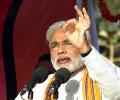
Narendra Modi has earned a ranking of eight out of 10 in an India Inc survey.

The finance minister's assertion that industry should not expect any spectacular announcements in the 2024 interim Budget suggest that the electoral imperatives of more tax concessions or higher expenditure on welfarist programmes could be far less pronounced than they were before the 2019 interim Budget, expects A K Bhattacharya.
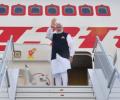
New initiatives to boost cooperation to ensure stability in the Indo-Pacific, ways to find peaceful solutions to the conflicts in Ukraine and Gaza and addressing concerns of the global South will be the focus of Prime Minister Narendra Modi's three-day visit to the US beginning Saturday.

Government on Friday hiked the import tariff value on gold and silver to $433 per 10 grams and $699 per kg, respectively, taking into account the volatility in the precious metals' global prices.

The primary and immediate impact of a depreciating rupee is on the importers who will have to shell out more for the same quantity and price. However, it is a boon for the exporters as they receive more rupees in exchange for dollars. The rupee depreciation has wiped away some of the gains that would have accrued to India from international oil and fuel prices dropping to pre-Ukraine war levels.

Accounting for the first Advance Estimates for 2017-18, an additional planned borrowing of Rs 200 billion, the fiscal deficit could come in at 3.35 per cent of GDP.
.jpg)
Pranab Mukherjee, who himself was Finance Minister, said he was 'not disappointed' by the current economic situation in the country.

The rupee has had a volatile run in the past one week.

A moderate recovery in Indian factories, exports and investments were probably the main drivers for an increase in overall growth in the quarter through March.
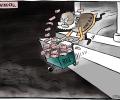
The windfall taxes on domestic crude oil production and fuel exports will generate close to $12 billion (Rs 94,800 crore) for the government in the remainder of the current fiscal while trimming profits of firms such as Reliance Industries Ltd and ONGC, Moody's Investors Service said Tuesday. On July 1, the government imposed windfall gain taxes on the export of petrol, diesel and aviation turbine fuel (ATF), and on the domestic production of crude oil. It has also mandated exporters to meet the requirements of the domestic market first.

In 2013, India suffered its worst currency crisis in more than two decades but has regained the confidence of foreign investors in part after its current account deficit has narrowed sharply and its foreign exchange reserves hit a record high

Even as the bilateral relationship between the two neighbouring countries remains hostile, there is growing coordination between India and Pakistan on one multilateral forum - the World Trade Organization (WTO). Both countries have made two joint submissions at the WTO as co-sponsors in the past two months. In June, Pakistan joined India, Cuba, and 44 African countries, seeking sufficient flexibility in intellectual property rights for developing countries to fight the Covid-19 pandemic.

Emerging market currencies including Indian rupee are likely to remain under pressure, though depreciation is expected to slow from here, Barclays said in a research report.

Seeking to dispel the perception of gloom and pessimism, Finance Minister P Chidambaram on asserted in the Lok Sabha that rupee will correct itself and the growth will bounce back.

India must announce liberal policies to attract foreign investors.

The government has promised to keep the deficit at 4.1%

Finance Minister P Chidambaram will woo foreign investors to invest in India as he begins his nine-day visit to the US on Tuesday.

Divestment in BPCL, SCI, Concor, NEEPCO, and THDC would help the Centre keep its fiscal deficit in check in the wake of subdued tax revenues and a Rs 1.45-trillion hit for the exchequer from corporation rate cuts.

Most immediately, he pledged to move slowly if needed in winding down an oil window that provides dollars directly to state-run oil companies

Now that the economy is growing at a higher-than-expected rate, it is time to accelerate the pace of fiscal consolidation, and the Budget could be a good starting point, argues Rajesh Kumar.

We import from China not because we love China, but because they sell us these things at cheap prices, points out Rathin Roy.

After a turnaround in performance by Indian equity markets since July that has seen the S&P BSE Sensex and the Nifty50 wipe out the year-to-date losses, analysts suggest investors start nibbling into stocks that are focused on the domestic economy. While they say intermittent corrections, led by policies of global central banks and other economic data, cannot be ruled out, analysts expect India's relative outperformance among global equity markets to continue as it looks better placed with a healthy economic recovery, and remains one of the fastest growing major economies. In this backdrop, Neeraj Chadawar, head of quantitative equity strategy at Axis Securities, believes that amid global slowdown, aggressive tightening by the central banks, and preference for domestic interests first (by the local government), export-oriented themes are likely to be muted or will deliver conservative returns in the near-term.

Huge gold imports have put pressure on the country's CAD, which in turn is affecting the value of rupee.

The fiscal deficit in the first three months of current fiscal stood at Rs 2.86 lakh crore or 51.6 per cent of Budget estimates for 2015-16.

The rupee breached the 80-mark against the dollar on Tuesday. The steady depreciation in the value of the rupee against the US dollar is likely to prove expensive for corporate India. The listed companies' revenue expenses in foreign currency or imports exceed their export revenues or revenue earnings in forex. In their latest financial year, BSE500 companies, excluding banks and non-banking finance companies and insurance (BFSI), reported combined forex expenses of Rs 12.31 trillion against forex earnings of around Rs 10 trillion.

India's economic growth is now 'extremely fragile' and needs all the support that it can get, as private consumption and capital investment are yet to pick up, RBI Monetary Policy Committee (MPC) member Jayanth R Varma said on Friday. Varma further said out of the four engines of growth for the economy, exports and government spending supported the Indian economy through the pandemic, but other engines need to pick up the baton now. " I like to think in terms of the four engines of growth for the economy: exports, government spending, capital investment and private consumption. "...while exports cannot be the main driver of growth because of the global slowdown, government spending is necessarily limited by fiscal constraints," he told PTI.

'Those trying to use these funds for quick gains should avoid them due to risk of being late to the party.'

A higher opening in the domestic equity market also supported the rupee but dollar's gain against other currencies overseas limited the rise of domestic unit, forex dealers said.

This is slightly better than the fiscal deficit position last year when it was 85.6 per cent of the Budget target.

By taking the mutual fund route, investors can take exposure to gilts with small amounts. Over a decade or more, returns from these funds tend to be sound.
India Inc on Friday said Prime Minister Manmohan Singh's assertion that the government will not impose capital controls, although reassuring to investors, must be supplemented with tough reform measures.

'She delivers on promises, especially on security issues which is a core concern for India.'

'Investors should consider small and midcaps only if they can handle volatility and have a longer investment horizon.'

Barring rice, spices, iron ore and pharmaceuticals, all the remaining 26 key sectors registered negative growth in May. Imports too plunged 51 per cent to $22.2 billion in May.
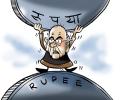
Fiscal deficit in first half of FY19 has already reached 95.3 per cent of full-year budget estimates.
 © 2026 Rediff.com - Advertise with us - Disclaimer - Privacy Policy - Sitemap - Feedback - About us - Terms of use - Grievances